Pages

Saturday, March 5, 2011

"Safe Box" Week with the French Students


French and American students working together for the "Safe Box" project 

Last week was by far the most fun week of school so far.  After returning from a week-long travel break, we skipped our usual Design and Structures classes in order to have a 5-day intense design charrette with the second-year French students.  Each American was paired with 3 or 4 French students, so finally, after all this time, students of both cultures were working together in the same room and got to know each other very quickly.

The assignment was simple and straightforward: choose a location, pick a disaster, and design a low-budget emergency housing unit (a "Safe Box") for the families who lost their homes.  However, with the added language barrier and different design backgrounds, a challenging and exhausting week ensued.  We were at school all day, every day -- hearing lectures, sketching our ideas, and consulting with our professors and teaching assistants.  I got lucky and was paired with 3 nice French girls who were very talented and motivated (Claire, Lise, and Barbara... they're so funny).  After they heard me speak a little French, they barely spoke English the rest of the week -- so my French improved a lot!

The three teachers for the week were guests from all over the world, and by the end of the 5 days, we loved them all.  There was Kevin Hinders from U of I, who gave a lecture on some of his sustainable work throughout the world; Jean-Christophe Grosso, a French architect who talked about his disaster relief work in Benin; and Yashar Hanstad, an Iranian-Norweigan architect from Tyin Tegnestue studios, who also did low-cost housing.  It was great to hear Professor Hinders' real American accent, something we realized we hadn't heard in months...  We also learned that Jean-Christophe used to work for Santiago Calatrava, which was awesome...  And everyone (especially the girls) fell in love with Yashar after hearing about his love for Radiohead and how his last project beat Zaha Hadid in a competition.

The 3 design teachers and the program coordinators
Yashar giving his comments
The final presentations on Friday were long, but they showed just how diverse our disaster solutions ended up being.  They were rather funny, too: while the French students had to present their parts in English, the Americans had to present in French.  Fortunately, no mocking occurred, and the day ended with a pleasant reception.  No one really wanted the project to end, because it had been such a success, both academically and socially.  (The number of my French friends on Facebook just skyrocketed! haha...)  We celebrated at a friend's apartment on Friday night, so several of the French and Americans got to mingle some more and talk about the week.  Yashar even showed up after his faculty dinner, and we talked about architecture while having some drinks until the early morning.  Overall, it was a great week that I'm sure none of us will ever forget.


Sunday, February 27, 2011

Saying Hola to Madrid, Seville, and Barcelona....

Seville, Spain
.... or as I like to call it, The Amazing Week of Sangria, or more accurately, The Great Search for Javier Bardem.

This past week was an incredible refresher from life in Paris: the sun was shining, palm trees were everywhere, the locals were friendly, and food was cheap!  It could not have been a better first encounter with Spanish culture.  We started out in Madrid and found it to be much more pleasant than we expected.  Our other friends had told us not to go there, or said that it wasn't very interesting -- but we realized that these thoughts stemmed from Madrid simply not looking as "Spanish" as other Spanish cities.  We arrived at Madrid's ultramodern airport on Saturday morning and quickly headed over towards our tiny "Las Musas" hostel.  We started off the day with an amazing tapas meal at a recommended restaurant, eating good paella and drinking sangria.  I was a tiny bit surprised to find that there was no Central American influence on Spanish cuisine whatsoever... and it was actually true that lunch didn't get going until well after 2pm.  Strange.  We walked around town for a little bit (central Madrid actually isn't very big) and came home for a lovely siesta.

That night we found another great tapas restaurant around 10pm, and dinner was only just starting.  We had to wait outside for a little while, but the host gave us a pitcher of sangria (as usual) to drink outside, and we ended up running into another group of kids from our program.  The tapas were delicious, and afterwards, we hung out at a dance bar for a while before going to bed.

Plaza Mayor
The next day we took a walking tour which began at the Plaza Mayor.  We learned about Madrid's history as the seat of the Spanish throne as well as its history with the Hapsburg Empire -- which explained why so many of its buildings looked like those in Vienna.  Our tour guide learned that we were architecture students (I think the frantic sketching gave us away) and told us about a really interesting cathedral an hour outside of town.  After hearing his description, we decided to be spontaneous and go visit it.  It was called the "Cathedral of Faith", built by a crazy old man in Mejorada del Campo... and it was the craziest church I've ever seen!  (Well... until 5 days afterwards.  But more on that later.)  It was completely built by this man and his nephews, with recycled and stolen materials, totally unsafe and totally illegal.  It was open to the public, but a big sign at the entry said "I am not responsible for anything that happens here."  We went ahead and explored nevertheless, admiring the hand-made bricks, stained glass windows, railings, and mosaics.  It was really scary to climb the tower stairs, and some of the floors seemed to be made of concrete only an inch thick, but it was great to see this guy's imagination at work.  It was quite the architectural adventure.  (New philosophy: if someone tells you your building shouldn't be built, prove them wrong and do it yourself!)

An ugly but impressive homemade cathedral
That night we visited the Prado Museum (Madrid's Louvre, basically) and ate a more traditional dinner.  A TV in the restaurant was playing the Spanish film awards ceremony live, and I realized, to my astonishment and horror, that I was within one mile of the legendary Javier Bardem.  (Sadly, we decided it would not be practical to break into Madrid's Opera House.)  We cheered in the streets for a while with a crowd of kids who were celebrating something... apparently basketball?... and went to a famous chocolate churros place afterwards.  Monday morning was hectic -- we had an 11am train to catch -- but Andrea, Sonia and I made it to the Reina Sofia Museum for its 10am opening.  We got to see Picasso's Guernica and other famous works by Salvador Dali, Joan Miro, and other modern artists.  I wish we had spent more time there rather than at the Prado Museum, because I found the 20th century artwork really interesting and much more "Spanish."

We entered Madrid's Atocha Station, which had a really cool mini rainforest inside, and after admiring a turtle farm for a while (???) we boarded our train for southern Spain.  This was yet another amazing European train ride, comparable to the trip from Berlin to Prague; I'm so glad we didn't fly!  The scenery was phenomenal.  We were surrounded by hills and mountains on all sides, and occasionally some ancient hilltop castles poked through the low-hanging clouds.  Finally we arrived in Seville, and I couldn't have been more excited.

A lovely day in romantic Seville
Once we found our hostel, unpacked, and started walking around the city, I knew one thing to be true: Seville was my ideal paradise.  A few key words will make it clear why I thought so:  Palm trees.  Sunshine.  Orange trees.  Guitar music.  Flamenco.  Beautiful people.  COLOR everywhere.  Our tour guide that afternoon showed us a beautiful palace-turned-hotel where Johnny Depp had stayed a few days earlier, and I could certainly see why celebrities would hang out in Seville.  We also saw the town's central cathedral (which featured a beautiful Islamic-inspired tower), the so-called "kissing street" (so tiny that two people could kiss across their balconies), and a Star Wars/Lawrence of Arabia film location (the Plaza de España).  I was forced to play a "French princess" in a historical skit concerning Christopher Columbus... very strange but very funny... and later we got ice cream and had our usual siesta.  We also found some time to go shopping (I swear, these girls have made me visit every single Zara and H&M in all of Europe) before finding dinner.  It ended up being a romantic Valentine's Day meal at a misleading Italian restaurant where we were pretty sure all of our food had been microwaved.... oh well.  To make up for it, we went into a bar across the street that seemed pretty popular -- it was ok, but filled mostly with Americans studying abroad.  So on our walk home (which was extremely long, given that Seville is the most labyrinth-like city I've ever been in) we were lucky to come across another bar that said "1 Euro Chupitos."  It was almost completely empty except for the bartender and a couple, but we ended up having a great time getting to know them, learning Spanish, and even buying the bartender drinks!

Plaza de España
On Tuesday, we got up early to see the Casa de Pilatos.  It was only 4 blocks away from our hostel... and after nearly 45 minutes of walking in the rain, we eventually found it (YES, Seville is THAT difficult to navigate).  This beautiful building complex was an Andalusian palace, whose detailed ornament really epitomized what I love about Islamic architecture.  Every inch of every floor, wall, and ceiling was painted or sculpted delicately.  The gardens were perfect; had it not been raining, I would have just sat there coloring orange trees all day.

Casa de Pilatos

I met up with Andrea and Kelsey at a nearby restaurant, one that we had been meaning to eat at, called Taberna Coloniales.  Hands down... BEST decision of the trip.  While we waited for Sonia, Kara, and Shachi to finish sketching at the palace, we sat at the bar and somehow managed to have a great conversation with the servers, even though they couldn't speak English.  The girls took a while, so we tried a few of the tapas specials and even got local wine samples.  There was some kind of fish covered in an amazing coffee-flavored sauce... potatoes with garlic and tomato sauce... chicken with almond sauce... if I could marry that meal, I would.  We left around 4pm and tried to sketch around town a little bit more.  And in the evening, we bought tickets to a flamenco show!  I was so excited, because flamenco originated in Seville and we found a place that wasn't too touristy.  The show at Casa de la Memoria was great -- it started off with just a guitar and a singer, and later, one female and then one male dancer performed.  It was utterly entrancing.  I was so captivated that I don't think I glanced offstage at all the whole time.  When the two of them finally danced together, I wished I knew flamenco myself, because the dance was so beautiful and so intense.  We got dinner at another recommended tapas bar, and after stopping by our favorite little bar again to say hello, we headed home.

Córdoba
Wednesday morning had been set aside for our trip to Córdoba.  As dedicated architecture students, we couldn't possibly go to southern Spain without seeing its most important architectural landmark: the Great Mosque of Córdoba, which was later converted into a Catholic Cathedral.  It was very hard to find, and the rainy weather didn't help, but we persevered and eventually found the huge "Mezquita" complex.  The outside was gorgeous, since the yellowish stone of the buildings and the palm tree gardens went together very nicely.  But it was the inside of the mosque that was truly astonishing.  A huge hall, expanding in every direction, was filled with columns as far as the eye could see.  The double-horseshoe-shaped arches are what make this building particularly famous, but even more impressive were the great pointed and "scooped-out" arches that separated different areas of the building.  (Fun architecture fact #1: some people say that the pointed arches of Gothic architecture were originally inspired by Islamic pointed arches.)  The cathedral, which was literally plopped down right in the center of the mosque, ruined the effect a little bit -- but it was nevertheless a beautiful building, full of intricate details and a beautiful mihrab.


That afternoon, we sketched some more and went back to our beloved restaurant for dinner.  The waiters were happy to see us again, and they joked around with us all throughout the night.  (One of them had a huge crush on Kara... it was so cute.)  Six excellent meals and six bottles of wine later (don't judge), we were about to leave, until a hoard of Portugese boys came in and convinced us to go out with them.  We had a fun-packed last night in Seville before sadly leaving the next day.

Our favorite restaurant and our favorite waiter
Most people usually aren't reluctant to travel to Barcelona, but we weren't eager to leave heavenly Seville, which was a shame.  To make things worse, our arrival in Barcelona involved a freezing walk in the pouring rain for 1 hour.  I decided to walk around town for a little bit -- I saw Las Ramblas (the main shopping street), Plaça de Catalunya, the old Gothic quarter of town, and the Marina (my first view of the Mediterranean!).  But I couldn't handle the cold for long, so I went back to the hostel in Les Corts where we spent most of the evening just lounging around and meeting fellow backpackers.  We had dinner at an authentic Catalonian restaurant -- really good, and rather French.  One of the difficult adjustments to make in Barcelona was dealing with the Catalan language.  I didn't realize how much more prominent it is than Spanish -- every sign, every menu, everything was in a language that none of us knew.  But since it seemed like half Spanish and half French, we managed to get by.

On Friday morning, we set out on a mission: to discover Gaudi.  THIS was what I had come to Barcelona for.  Referring back to my earlier comment about that crazy cathedral in Madrid -- well, when we finally saw Gaudi's cathedral in Barcelona, I knew I would never see a more awesome building ever again.  Ever.  The Sagrada Família is Gaudi's most famous work, probably (a) because it looks really weird, (b) because it is incredibly complex, and (c) because it's been under construction for 130 years.  I can't wait for it to be finished in 20-40 years; I'll definitely go back for that grand opening.  I was initially annoyed by the 12€ entrance fee, but then I realized, Hey! I'm contributing to its construction!  The church is covered in weird symbolic shapes, and the inside feels like a forest of alien trees, with the stained glass bathing the whole room in crazy colors... I seriously wanted to stay in there forever.  (Fun architecture fact #2: Gaudi figured out the church's design by hanging weights on strings.  He then flipped the whole model upside down to create a perfectly stable structure.)


An aerial photo I found of Gaudi's Sagrada Família Church
The Passion Facade entrance


In the afternoon, we made our second-most-important Gaudi pilgrimage: to the Parc Güell.  What a delightful afternoon... we looked over all of Barcelona, sat in the sun, listened to live music, and walked through Gaudi's twisting and turning stone passages.  After visiting Gaudi's house, I got lost for a little bit -- I delved a little too deep into the park and was wandering into people's backyards at one point, oops! -- but we reconvened as the sun set.  I loved the park so much that I knew I would come back to do an in-depth architectural study (the assignment for the week).

Main staircase up to the Parc Güell
Anyone remember America's Next Top Model here?
Upper terrace of the Parc Güell
That night we had dinner near Catalunya and afterwards went to the famous Espit Chupitos bar.  This place had the craziest shots I'd ever heard of: some of which were the "Harry Potter" (lit on fire), the "Finding Nemo" (green with whipped cream), and the "Boy Scout" (you had to roast a marshmallow over it before drinking it).  Unfortunately most of the people there were Americans... I don't know where all the Spanish kids were... so we didn't stay for long.  On the plus side, we had met some kids from Ireland at our hostel who tagged along -- so it was fun to get to know them while discovering Barcelona together.

Saturday was pretty much Gaudi: The Sequel, since the highlights of the day were seeing two of his houses in Barcelona.  The Casa Batllo was really weird and really awesome: it looked alive, like it was made of bones and dragon scales.  Down the street, La Pedrera (a.k.a. Casa Mila) was also really cool. These were some of the first buildings to use such crazy curved forms; future architects like Le Corbusier and Frank Gehry can thank Gaudi for that.  In the afternoon, we walked along Barcelona's beach for a while.  I also went to see Mies van der Rohe's Barcelona Pavilion, a really interesting modern home built with beautiful, pristine materials.  Our dinner at a traditional Barcelona restaurant and our evening at a friend's house were also very nice, but I was more excited to revisit Parc Güell the next day.  On Sunday morning, I sketched there for a few hours, soaking in as much of that wonderful atmosphere as I possibly could.  Our whole group joined up again for lunch outside the Sagrada Familia (fittingly), so I got to see it one last time.  Barcelona on the whole was rather exhausting and a little too big for me to handle in 4 days, but seeing Gaudi's work made it worth it.  Discovering Spain overall was an even better experience than I expected it to be.  I may not have run into Javier Bardem à la Vicky Cristina Barcelona, and it may not have been swimsuit weather, but the people I met and the experiences we shared were unforgettable.

Barcelona Pavilion
Casa Batllo
La Pedrera

P.S.  Thanks to everyone who let me borrow their pictures... I lost my camera.  :(

Sunday, January 30, 2011

William J. R. Curtis Week

During the week of January 11 - 15, all of our other classes and school activities were put on hold as we welcomed a visiting lecturer to give us a crash-course in modern architectural history for five days.  Luckily enough, our program didn't just bring in anyone -- they brought in William J. R. Curtis.  In other words, the craziest and most awesome architectural historian around today.  His book on modern architecture is used at U of I, but also has international popularity, since our French friends use it as well.  Essentially, this guy is an expert in the field, having seen everything and met everyone of importance in the architectural community.

Needless to say, we were all excited to meet this guy and hear what he had to say.  He started with an introductory lecture on the early works of Le Corbusier, and I could tell right away that he was an intelligent, energetic, and sassy kind of guy.  In between slides, he went off on tangents about his time living in a Frank Lloyd Wright house and his breakfast conversations with Frank Gehry.  Think Horace Slughorn: well-connected, a little arrogant, but still likable.  

After another lecture on the principles of Frank Lloyd Wright architecture, the whole class took a short bus ride to the town of Poissy, where we would be visiting the Villa Savoye.  For those of you who don't know, its legendary Swiss/French architect, Le Corbusier, was the pioneer of the modern movement in architecture during the early 20th century.  Last year, we had drafted the Villa Savoye and thought nothing of it -- but finally seeing it in person was positively mind-blowing.
My sketch of the Villa Savoye entrance
The house looks kind of like a weird design from the 70's, but it was actually built in 1928.  It was incredibly ahead of its time.  Walking throughout all of the rooms was the best part, because the way each space flowed into the next was extremely creative.  I loved Corbu's philosophy on the use of long, strip windows: "You don't have a great view unless you frame and limit the view."  A huge wall of glass turned out to be a sliding door onto the roof terrace; I decided this house would be the perfect place for a Gatsby-themed party.  After sketching for a while, we headed home very tired but very happy, shocked to have been so inspired by such a simple-looking building.

Two rooftop terraces and a GIANT sliding door

The next day, William gave us two more lectures in the morning, this time about German architect Mies van der Rohe and Finnish architect Alvar Aalto.  In the afternoon, we visited Villa La Roche, a house by Le Corbusier in the heart of Paris.  The site conditions weren't ideal (it was a very tight lot) but I liked what Corbu did with the space.  His use of balconies and curving ramps was pretty cool.  It adhered to his "5 Points" ideology by having 1) pilotis to sit upon, 2) a free plan, 3) a free facade, 4) strip windows, and 5) a roof terrace.
My sketch of the living room
On Thursday, we started off the day with a lecture on the late works of Le Corbusier (such as Ronchamp and La Tourette, which we'll be visiting later in the semester).  Then we talked about Louis Kahn and Jorn Utzon (who did the Sydney Opera House).  In the afternoon, only 16 of us went with William into Paris to see the Maison de Verre (House of Glass).  This house was designed by Pierre Chareau, from whom Le Corbusier later took inspiration.  Again, it was an incredibly avant-garde home built in 1931 -- the walls were made of glass blocks for the first time ever, it was supported by soaring steel columns, its staircases seemed to float... I would definitely live there.


SIDE NOTE:  To see an awesome video about cinematography and architecture, featuring many of the world's most famous buildings, watch this 100% computer-animated masterpiece.  Just 10 minutes long.

On Friday morning, class met on the southern end of Paris at the Cité Internationale.  This was a cool area I had never seen before: it felt like an American university campus!  The large grounds (very quad-like) were surrounded by an Illini-Union-esque center and dorms for students of various countries.  The Japan House looked very Japanese; the Mexico House had Aztec decorations; the Italy House looked very Baroque... etc etc.  We made a visit to the American House, of course.  But what we went to see was the Pavillon Suisse, or Swiss Pavilion, which was designed by Le Corbusier.  We could see how his style was changing at that point: instead of a boxy white plaster facade, he used concrete to form a lot of curved shapes.  We went next door to his Brazil House which was even cooler because it used lots of crazy shapes and colors.  

Cité Internationale welcome building

Le Corbusier's Pavillon Suisse dormitory
Saturday was the last day of our week-long architecture extravaganza, so rather than hearing more lectures, we squeezed in two more important site visits.  In the morning, we all took a bus to the French countryside behind Versailles.  We arrived at the Maison Louis Carré after the beautiful drive, and it ended up being one of my favorite buildings that we saw.  Atop a hill in the quiet woods sat a huge house designed by Alvar Aalto, the only thing that he ever built in France.  This place was built in 1957, but it might as well have been brand new: it was ultra modern but also woodsy, with a very natural vibe. It was truly an ideal house: a great rolling ceiling led down into the vast living room, which had an amazing view out onto the surrounding landscape.  Every bedroom was arranged perfectly, with great views, built-in furniture, and even a sauna.  All of the furniture and lighting was designed by Aalto himself, which was very impressive.  Even now, as I'm designing my own building for studio, I realize that Aalto's work has inspired me a lot (his use of materials, and the way the roof sloped down into the hillside, were just great).  

View from behind

My sketch of the front facade on the hilltop
Entrance to the living room
A section showing how the roof and ceiling slope down along the hill
Finally, in the afternoon, our class met up for a final visit to Le Corbusier's personal apartment in Paris.  It was a small place, and much more modest than his designs for others, but it was still cool to see where he lived and worked.  We have one more William J. R. Curtis week planned for later in the semester -- and I can't wait.  I'm sure it will be intense and exhausting, but seeing all of these landmarks has been 20 times more useful than looking at photos in textbooks.

Saturday, January 29, 2011

Christmas Break with the Dauls

This is a little after-the-fact, but I thought I might put up some photos from when my family visited me over Christmas break.  We were in Paris for 6 days, living in the lovely St. Germain neighborhood on the Left Bank, and then went to London for 4 days after that.  Even in Paris, as I played tour guide for the week, I still managed to discover some new treasures:

Grand staircase of the Opera Garnier
Opera Garnier hallway

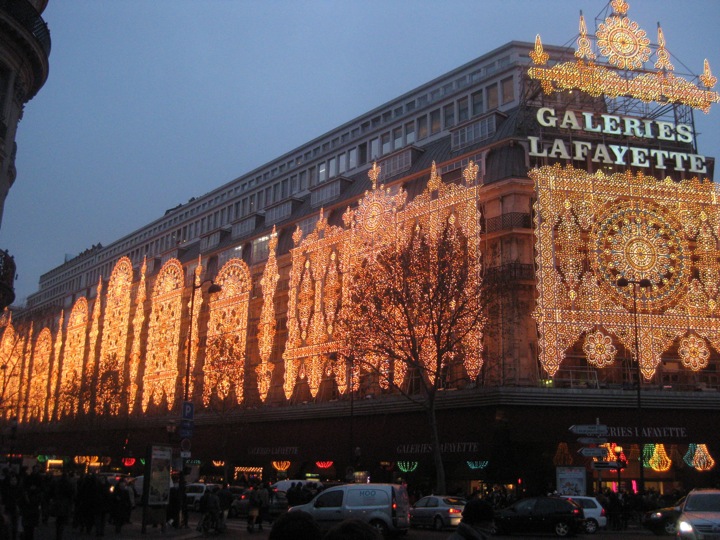
Best department store decorations ever
Inside the Galeries Lafayette
The Champs Elysées at Christmastime 
Now to London: a side street off of Oxford
Harry Potter ads on a double-decker red bus... so British! 
Carnaby Street decorations
My last stop before heading back to Paris: a little disappointing, but a must-see nonetheless.
I can't wait to go back to London sometime, whether it's this year or later in life, because it seemed like such an upbeat and fun city.  Maybe when it's a bit warmer, though, next time!

Tuesday, November 23, 2010

A Very-Harry Potter Weekend in Edinburgh

Edinburgh Castle
This past weekend was cold, rainy, and exhausting -- but totally worth it.  On Friday night I flew to Edinburgh, Scotland, to meet up with my friend Matt who's studying in Aberdeen.  (Note: the city is pronounced eh-din-burr-ah.)  It might have been stupid, but it was truly shocking to see that these people really do drive on the left side of the street.  It took me all weekend to get accustomed to looking right when crossing a street, and I nearly could have died several times!  So right away, even on the bus ride into the city, my experience felt rather surreal.

Matt brought along his Scottish friend Michael, and together we walked from the bus stop in central Edinburgh to his sister Kathy's apartment.  Kathy lived in a nearby neighborhood in a fancy apartment with a great view of the city, and she could not have been more hospitable.  Right away when we arrived, which was fairly late at night, she had set everything up for us and asked, "Can I get ya a cup o' tea, there?" like any normal Scot would.  We spent the night watching some amazing British comedy shows -- I was so excited to be watching TV in English and understanding everything.

I got a great night's sleep, seeing as the two boys accompanying me were extremely lazy like all college guys are.  Even having showered and eaten breakfast, I had time to listen to my Deathly Hallows audiobook while drinking tea and admiring the city from the big kitchen window.  (Don't judge... how could you go to Scotland and not listen to Harry Potter?!)  We walked through town along Princes Street, the central boulevard dividing Old Town from New Town, where every other shop was blasting bagpipe music and selling kilts and various tartan-patterned items.  We crossed over a bridge to Old Town and turned on the Royal Mile (surprisingly, a mile-long road connecting two royal buildings...) until we reached the Scottish Parliament.  Our design professors in Versailles had raved about this brand-new building, so I thought I ought to see it.  It was pretty ugly on the outside (and every Scottish person I talked to just hated it) but the inside was laid out in an interesting way.  Matt, Michael and I then decided to brave the cold and climb the Salisbury Crags, the beautiful cliffs on Holyrood Hill.  It was more of a mountain than a hill, and after climbing at least 900 feet up the wet, muddy hillside, we finally reached King Arthur's Seat.  Arthur's Seat is the highest point in Edinburgh, and legend has it that King Arthur established his dominion over the Scottish territory from that very spot.  The view was phenomenal: we could see downtown Edinburgh, the Castle perched atop another hill, and the Firth of Forth (the North Sea jutting inward) with hazy islands in the distance.

Holyrood Hill
View of the Firth of Forth from King Arthur's Seat
By the mid-afternoon, it was time to climb down the hill (which took twice as long as coming up, and resulted in all of my clothes being completely drenched and muddy).  We grabbed some food and headed over to the Odeon Theatre, where I could not contain my excitement, since we were finally seeing Harry Potter!  No spoilers -- but the movie was awesome, much more serious and intense than the others.  Afterwards, we went to a pizza place for dinner, and then Michael showed us Edinburgh's pub scene.  We sat next to a bunch of really nice guys at the first pub, and throughout the night I got to try some really good beer and Scotch.  (I still can't stand whiskey... but it was definitely better than usual.)  Late that night, we met up with Kathy and her friends, who confirmed my notion that all Scottish people are extremely friendly.  Along with Michael, they explained why Scottish people can't stand English people, which was pretty funny.  We grabbed some haggis on the way home, and I could not believe how good it was!  It sounds disgusting -- sheep liver, heart, and lungs mashed up with oatmeal and boiled in sheep stomach, then fried -- but it was the perfect antidote to the cold, rainy weather.  We happily finished our haggis and drank some more tea while watching TV, and I passed out on Kathy's comfy couch before long.

On Sunday, I was determined to get up earlier and see the rest of the city.  Michael slept in, so Matt and I set out for the most exciting part of the entire trip: our search for the café where J. K. Rowling wrote the Harry Potter series.  Along the way there, I literally did a double-take and stopped in my tracks when I saw the entrance sign for the Balmoral Hotel.  I literally swerved around and dragged Matt inside as I realized, in awe, that this was the place where J. K. Rowling finished the second half of the series (once she had real money).  It was super fancy, of course, and I wish I could have seen the statue upstairs where she famously scribbled a note when she finished Deathly Hallows in 2007.


After leaving and getting turned around on several little side streets, we finally found the Elephant House Café in Old Town.  The café was named differently a few years ago, but it was nonetheless purely magical to be in the place where such a wonderful story began.  We sat and had lunch in the exact same room where, years ago, Jo Rowling created the early Harry Potter books day after day.  By far, the best part of my experience there was seeing the view onto which the café looked.  It could not have been more inspirational for a series like Harry Potter: her table looked out onto a beautiful graveyard, dotted with eerie headstones, and behind it loomed the gorgeous Edinburgh Castle atop a giant cliff.  I felt like a loyal Potter devotee on a pilgrimage... it was surreal to be in a place where, really, one woman changed the history of literature forever.


Inside the literary landmark... the very tables where Harry Potter was written
The view out of J. K. Rowling's table's window onto the graveyard and the castle
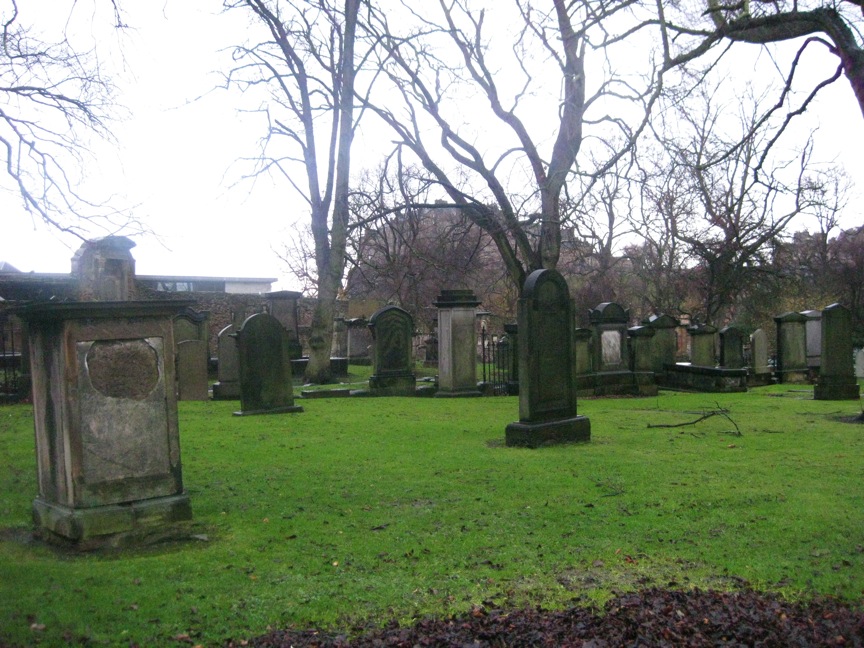
Matt and I met up with Michael again for a free tour of Edinburgh in the afternoon.  Our tour guide was an Australian living in Scotland, and he was full of great stories about Edinburgh's history.  I really got a feel for how spooky the city is -- it's full of eerie passages, haunted buildings, and has lots of ghost stories.  We saw a private boys' school that might have very well been the inspiration for Hogwarts.  After that, we finally ventured into the Greyfriars Kirkyard, the graveyard overlooked by J. K. Rowling's old café.  It was a creepy but beautiful place, and I was giddy when I saw some of the graves our guide pointed out.  There was the tomb haunted by a poltergeist (apparently ranked one of the "Scariest Places on Earth"), the tomb of a McGonagall, and coolest of all, a headstone with the names "Tom Riddell Sr." and "Tom Riddell Jr." marked upon it.  Clearly, J. K. Rowling got lots of inspiration when wandering that cemetery.

The George Hariot School in the distance, inspiration for Hogwarts
Inside the Greyfriars Kirkyard
Tombstone of the two Tom Riddles!
Our tour guide took us to some spots that gave us amazing views of the castle, which really is Hogwarts-esque in the way it's perched upon the hillside, even though it's not in the Gothic style.  Finally, after a great story about Scotland's Stone of Destiny and how it's traveled back and forth between Scotland and England, the tour was over and it was time to head home.  The three of us packed up at Kathy's, thanked her as much as possible, and left to catch a bus to the airport.  My shoes were soaked through and I was absolutely freezing, but nothing could stop me from feeling exultant.  The weekend as a whole was fascinating; Scotland was just as beautiful as I pictured it, and the entire time, I felt like I was living a fairy tale.  I can't believe that people actually live there.  Seeing the seventh Harry Potter movie was fun, but I will never forget how awesome it was to see the places where that amazing story was actually created from the start.  Overall, I can't wait to return to Scotland -- because the food, the drinks, the landscape, and the generous people -- everything was too good to be true.

Walking along Princes Street
One last view of the Castle